Through a UK winter, hay or haylage becomes most of what your horse eats. That makes it the biggest single influence on your horse’s nutrition, and the place to start. This guide covers how much hay to feed, where winter forage usually falls short, and what to add to fill the gaps.
Winter feeding at a glance
- Start with the hay. It is most of the winter diet, so the bucket feed should fill its gaps, not repeat what it supplies.
- Weigh it. About 2% of bodyweight a day to maintain, and no less than 1.5% for weight loss. How much hay
- Expect low protein. 83% of the forage samples we test fall below 8% crude protein as fed. Why protein is short
- Balance the minerals. Iron, manganese and calcium are usually high; copper, zinc, magnesium, selenium, iodine, phosphorus and sodium are usually short. Minerals
- Watch the ratios. Calcium is usually plentiful already, and the balance between minerals matters as much as the amounts. Ratios
- Test your forage. An analysis shows exactly what your hay supplies, so the balancer can match it. Forage testing
- Every day: salt, unfrozen water, omega-3, and vitamin E once there is no fresh grass. Salt and water
- Laminitis-prone? Check ESC + starch is below 10% as fed. Winter laminitis
What do horses eat in winter?
Horses get their nutrition from three places: water, forage (grass, hay or haylage) and bagged feed. In winter, forage does almost all of the work. Bagged feeds are a very small part of the daily diet by comparison, so the hay or haylage has far more impact on your horse’s health than the choice of bucket feed.
Even with plenty of land, most horses need hay through the winter. There may still be grass, but its protein, omega-3, vitamin E and energy fall sharply as the weather gets colder. After a frost, many horses leave long winter grass and choose hay or haylage instead.
Because hay or haylage is the greatest part of the winter diet, it makes sense to find out what is in it, then fill the gaps in the bucket feed.

How much hay does a horse need in winter?
Feed hay by weight, not by eye. Following Dr Eleanor Kellon VMD and the ECIR Group, feed about 2% of bodyweight a day to maintain weight, and no less than 1.5% for weight loss, which keeps enough fibre for gut health.
| Bodyweight | Weight loss (1.5%) | Maintain (2%) |
|---|---|---|
| 300 kg | 4.5 kg | 6 kg |
| 400 kg | 6 kg | 8 kg |
| 500 kg | 7.5 kg | 10 kg |
| 600 kg | 9 kg | 12 kg |
Haylage holds more water, so it takes roughly 7 to 8 kg of haylage to replace 6 kg of hay. Spread the daily amount through the day in slow feeder nets, so your horse goes no more than about 4 hours without forage. Our hay calculator works out the daily amount and how to split it between nets.
Hay also helps keep horses warm. Fibre is fermented by microbes in the hindgut, and that fermentation produces heat. In a cold snap, add hay first, then a larger bucket feed. High fibre helps weight maintenance.
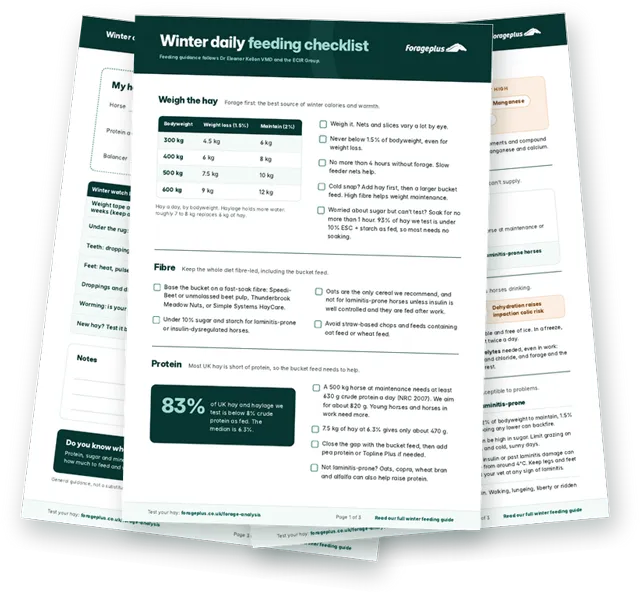
Free checklist: this whole guide on three pages for the feed room
The winter daily feeding checklist turns this guide into three printable pages you can tick off each day.
- Hay amounts by bodyweight, with soaking guidance
- The daily essentials hay can’t supply
- A winter plan and watch list to fill in
Free PDF, three pages, with a print-friendly version.
Check your inboxYour winter daily feeding checklist is on its way. If it isn’t there in a few minutes, look in your spam or promotions folder.
By continuing you agree to receive emails from Forageplus with your checklist, feeding advice, news and offers. Unsubscribe any time. See our privacy policy.
Does my horse need hard feed in winter?
Most horses don’t. Hay is the best source of winter calories: it keeps the gut working and produces heat as it is fermented. Increase the hay first, then add calories from low-sugar fibre if your horse still needs more.
Oats are the only cereal we recommend, and they are not suitable for laminitis-prone or insulin-dysregulated horses. Barley and coarse mixes are high in starch, and for most horses cereals are unnecessary when there is enough hay. If a horse in hard work needs extra energy, read our guide to feeding oats first.
Alfalfa is low in sugar and higher in protein and calories than grass hay, which can suit a horse that needs condition. It is very high in calcium, though, adding to the calcium already plentiful in forage, so the minerals in the bucket need rebalancing around it.
Keep the whole diet fibre-led, including the bucket feed. Base it on a fast-soak fibre: Speedi-Beet or unmolassed beet pulp, Thunderbrook Meadow Nuts, or Simple Systems HayCare. For laminitis-prone or insulin-dysregulated horses, choose feeds under 10% sugar and starch. Avoid straw-based chops and feeds containing oat feed or wheat feed.
Why winter hay is often short of protein
Low protein in the diet leaves horses hungry. A horse on ad lib hay or haylage will try to eat more to make up a protein shortfall, which works against weight control in good doers.
Our forage analysis data
Winter forage is usually short on protein
That 8% is only the resting minimum. A young, growing horse needs around 11% of the total diet, which is why under-fed youngsters so often look leggy and poorly muscled.
Most winter hay will not, on its own, cover the protein needed to build and maintain muscle, skin and hooves. Balancing protein and the essential amino acids to your forage fills that gap. Our protein calculator shows how your hay compares.
Minerals: match the bucket to the hay
Forage is where horses get most of their minerals, and hay or haylage is simply dried grass. If the grass is not balanced, neither is the diet. That is where the one-size-fits-all, broad-spectrum approach lets horses down: it ignores the largest part of what they eat.
In grams, a 500 kg horse at maintenance needs at least 630 g of crude protein a day (NRC 2007), and we aim for about 820 g. Young horses and horses in work need more. The median hay we test is 6.3% crude protein as fed, so 7.5 kg of it supplies only about 470 g.
Close the gap with the fibre feed and micronised linseed first, then add pea protein or Topline Plus if needed. For horses that are not laminitis-prone, oats, copra, wheat bran and alfalfa can also help raise protein.
Livestock farmers have balanced animal diets to their forage for decades, because it gives healthier animals. The same approach suits horses even more, as horses are often kept on small parcels of land where overgrazing and compaction push up antagonist minerals such as iron and manganese.
The mineral picture
Forage minerals: excess vs short
UK forage does not supply minerals evenly. A few are almost always too high, and because forage is the bulk of the diet, they block the uptake of the ones that are too low.
Commonly in excess
High in most UK grass, hay and haylage, and they block the absorption of other minerals.
Commonly short
Some are blocked by the minerals on the left; others are simply low in UK forage. These are what a balancer needs to add.
This is why a balancer should be matched to grass and hay: low in iron and manganese, with no added calcium, and supplying what is short. Calcium is usually already plentiful in forage for adult horses.
Calcium: usually already more than enough
Calcium blocks the uptake of phosphorus and magnesium, so the ratio between them matters for health, not just the amount of each. Calcium is also easily supplied: forage is usually high in it, and common bucket feeds such as beet pulp and alfalfa add more.
Our statistical analysis of forage shows that, for adult horses, it is best not to add calcium every day unless your forage analysis shows it is needed.
Ratios matter as much as minimums
The NRC’s Nutrient Requirements of Horses (2007) sets minimum daily amounts for each mineral, but the ratios between minerals are just as important. Iron and manganese are often present in large excess compared with copper and zinc, and at those levels they block the uptake of both.
That matters because copper and zinc are vital for liver health, skin and hoof health, digestive health and many of the reactions the body relies on to fuel, build and repair its tissues. When you add minerals, choose a balancer low in iron and manganese but high in copper and zinc, matched to the profile we see in UK forage.
Test your forage, or use a balancer matched to grass and hay
The most accurate approach is to test your hay, haylage or grass for protein and minerals: calcium, phosphorus, magnesium, sodium, potassium, chloride, iron, copper, zinc, manganese, selenium and iodine. You can then balance your horse’s diet to the actual result.
Many supplements are designed to put a patch on problems that start with an unbalanced diet. Balancing to your forage instead fixes the basics, and a diet built on the right basics supports healthier skin, muscles, hooves, digestion and immune function.
If you cannot test, use a balancer matched to grass and hay, formulated from a large database of forage analyses across a wide area. Mineral content varies hugely, even between neighbouring fields, because it reflects soil health, pH, compaction and grazing pressure, so a small or regional dataset is not a reliable base.

Why your fields affect the minerals
The minerals in grass, and so in hay and haylage, reflect the soil it grows in. Geography plays a part, but how the land has been cared for is often more powerful, which is why neighbouring fields can test very differently.
- Soil pH affects which minerals grass takes up, and often results in high manganese.
- Compaction reduces drainage and often results in high iron.
- Overgrazing weakens grass so the roots become shallow, with less access to some minerals and more uptake of the antagonists iron and manganese.
- Well-managed soil, where the minerals have been looked after, grows grass with a very different profile from a field where soil health has been ignored.
If your horses graze the same fields year after year, a soil analysis shows what is happening underneath, and testing the grass or hay shows what actually reaches your horse.
Matching nutrition to forage matters even more for horses under extra demand: pregnant and lactating mares, growing youngsters and horses in work. Read more in 10 ways to know what minerals your horse needs.
Horse not drinking in winter? Salt and water
Horses often drink less when it is cold, and a horse that already drinks little is more at risk of a slow gut. Keep water unfrozen and always available, and break ice at least twice a day in a freeze.
Salt helps keep horses drinking. Most forage is low in sodium, so feed 10 to 20 g of plain salt a day for a 500 kg horse, roughly 1 level tablespoon, more if sweating or on soaked hay, unless your analysis shows otherwise.
Do horses need electrolytes in winter? No, not even for horses in work, when you feed a balancer matched to grass and hay. Sodium and chloride are the electrolytes most likely to run short in UK forage, and plain salt supplies both. Forage already provides plenty of potassium, and the balancer covers the other electrolyte minerals. A clipped horse that sweats in work simply needs a little more salt that day. Our guide to electrolytes for horses explains how much.
Omega-3 and vitamin E in winter
Fresh grass is the main natural source of both, so they drop sharply once horses are on hay. Both are essential basics that hay, haylage and winter grass can’t supply. For omega-3, feed micronised linseed: following the ECIR Group, a minimum of 42 g per 220 kg of bodyweight a day, which is at least 90 g for a 500 kg horse.
Vitamin E also falls once there is no fresh grass. Around 2,000 IU a day suits a 400 to 600 kg horse at maintenance or in light work. Horses in harder work or laminitis-prone horses benefit from more: see our natural vitamin E.
Managing weight and condition
Horses that are overweight or underweight are more susceptible to problems such as laminitis and colic, so keep an eye on condition all winter.
Use a weight tape and body condition score every 2 weeks, and check under rugs, where changes hide easily.
Use what your forage supplies to decide how much to feed and what to add, rather than guessing.
Regular exercise makes muscles more sensitive to insulin, so they take up glucose more readily. Hand walking, lungeing, liberty work or riding, if sound and free of laminitis.

Horse losing weight in winter?
Start with the hay. A horse that is dropping condition usually needs more forage, not more bucket feed. If your horse is not laminitis-prone, feed hay freely, and check its teeth (if hay is being dropped or quidded) and check for parasites.
Then make the bucket feed larger and denser with fast-soak fibre such as unmolassed beet pulp, plus micronised linseed, introduced gradually. Linseed can be fed up to 1 g per kg of bodyweight a day; above that, the high fat content can suppress appetite.
Check protein too. A horse short of protein loses topline even when it gets enough calories, and most winter hay is low in protein. For older horses, see our old horse feeding tips.
Can horses get laminitis in winter?
Yes. Horses with insulin dysregulation, EMS or PPID remain at risk through the winter, for two main reasons.
Frosty grass. Grass that is growing slowly in cold, bright weather stores sugar rather than using it for growth, so frosty grass can be high in sugar. Limit grazing for at-risk horses on frosty mornings and cold, sunny days.
Cold-induced foot pain. Dr Eleanor Kellon VMD describes horses with high insulin that become lame in cold weather, often from around 4°C, even on a well-controlled diet. Horses with previous hoof damage from laminitis can also become sore in the cold. Cold narrows the blood vessels supplying the feet, and in these horses the effect is exaggerated. Keeping the legs and feet warm, with lined boots or leg wraps, is the first step. Speak to your vet if your horse shows any signs of laminitis.
For hay, keep ESC + starch below 10% as fed. Our hay soaking checker tells you whether yours needs soaking.
Common winter challenges and solutions
What to watch out for when choosing a balancer
Mineral supplements with a little bit of everything. This scattergun approach often over-supplies the antagonist minerals and under-supplies the ones forage is actually short of. A ratio approach based on a large database of forage analyses is far better.
Regional balancers. Forage can vary hugely within a region and even between neighbouring fields. A balancer built on a narrow regional dataset is prone to statistical error, so if in doubt, ask to see the data behind it.
Know what your winter hay supplies
Our NIR nutritional analysis reports protein, calories and ESC + starch, so you know how much to feed and what to add. No kit to wait for.
Test your haySee the winter balancerWinter feeding: quick answers
What do horses eat in winter?
Mostly hay or haylage. Winter grass is short and low in protein, omega-3, vitamin E and energy, so forage fed in the stable or field becomes the bulk of the diet. A small bucket feed then fills the gaps the hay leaves, rather than adding a little of everything.
How much hay should I feed my horse in winter?
Feed about 2% of bodyweight a day as hay to maintain weight, and no less than 1.5% for weight loss, in line with Dr Kellon and the ECIR Group. For a 500 kg horse that is 7.5 to 10 kg a day. Weigh it, as nets and slices vary, and allow more by weight if you feed haylage.
Does eating hay keep horses warm?
Yes. Fibre is fermented by microbes in the hindgut, and that fermentation produces heat. In a cold snap, add hay first, then a larger bucket feed. High fibre helps weight maintenance.
Do horses need supplements in winter?
Most do, but only for specific gaps. Of the forage we test, 83% falls below 8% crude protein as fed; copper, zinc, magnesium, selenium, iodine, phosphorus and sodium are usually short; and omega-3 and vitamin E drop once there is no fresh grass. Salt is needed every day. Testing your hay shows exactly what to add.
What is the best hay for horses in winter?
A hay you have tested. For a laminitis-prone horse, ESC + starch should be below 10% as fed, and ideally crude protein should be at least 8% as fed. Our analysed meadow hay comes with its results.
Can I feed grass or hay pellets in winter?
Yes. Soaked hay pellets or grass nuts can replace part of the hay, which is useful for older horses with poor teeth. Count them by weight towards the daily forage amount, and choose a low-sugar product if your horse is laminitis-prone.
How much salt does a horse need in winter?
10 to 20 g of plain salt a day for a 500 kg horse, roughly 1 level tablespoon, more if sweating or on soaked hay, unless your forage analysis shows otherwise. Salt helps keep horses drinking, which matters when many drink less in the cold.
Do horses need hard feed in winter?
Most don’t. Hay is the best source of winter calories and keeps horses warm as it is fermented. Increase the hay first, then add a fibre-led bucket feed such as unmolassed beet pulp if more calories are needed. Oats are the only cereal we recommend, and not for laminitis-prone horses.
Why is my horse losing weight in winter?
Usually because it is not getting enough forage for the cold, or the hay is low in protein or calories. Feed more hay first, check teeth and parasites, then add a larger, denser fibre feed such as unmolassed beet pulp with micronised linseed. Testing the hay shows whether protein is the gap.
Can horses get laminitis in winter?
Yes. Frosty grass can be high in sugar, and Dr Eleanor Kellon VMD describes horses with high insulin becoming lame in the cold as blood flow to the feet drops. Horses with previous hoof damage from laminitis can also become sore. Limit grazing on frosty, sunny days and keep at-risk horses’ legs and feet warm.
Do horses need electrolytes in winter?
No, not even for horses in work, when you feed a balancer matched to grass and hay. Plain salt, 10 to 20 g a day for a 500 kg horse, supplies the sodium and chloride most likely to run short. Forage already provides plenty of potassium, and the balancer covers the other electrolyte minerals. If your horse sweats, add a little more salt that day. See our guide to electrolytes for horses.
Check out our other articles on horse feeding.