Methionine for horses is being discussed more often in equine nutrition because it sits at the meeting point of protein quality, hoof health, muscle health and forage quality.
It is not a fashionable “magic” nutrient. It is one of the building blocks the body needs, regularly supplied through the diet, for normal muscle function, keratin formation, hair growth, immune function and overall health.
For many UK horses, forage is the major part of the diet. That means the horse’s nutrition depends heavily on what grass, hay or haylage supplies in protein, minerals, energy and certain amino acids.
A forage analysis showing adequate crude protein does not automatically prove that amino acid requirements are fully met.
There is also a changing soil story. UK sulphur dioxide emissions have fallen sharply since around 1990 due to cleaner fuels, reduced coal burning and pollution controls, which may have altered British soils and modern forage.[1]
Quick Summary
Methionine connects protein quality, sulphur status and forage-based horse nutrition.
Methionine is an essential amino acid for horses, involved in protein synthesis, hoof horn, coat, muscle health and antioxidant pathways.
Cleaner air since the 1990s has reduced sulphur dioxide emissions in the UK, which may have lowered sulphur inputs into British soils and modern forage.
Sulphur is needed by plants to make sulphur-containing amino acids such as methionine, so low soil sulphur may influence protein quality in forage-based diets.
Crude protein does not automatically show amino acid balance. A forage may appear acceptable on paper while still being limited in key amino acids such as lysine or methionine.
Forageplus forage analysis commonly shows low crude protein in UK hay and haylage. Where forage protein is low, key limiting amino acids such as lysine and methionine deserve closer attention.
Main takeaway
Methionine should be considered as part of the wider forage, sulphur, protein and amino acid picture, not as a standalone “magic” supplement.
What Is Methionine?
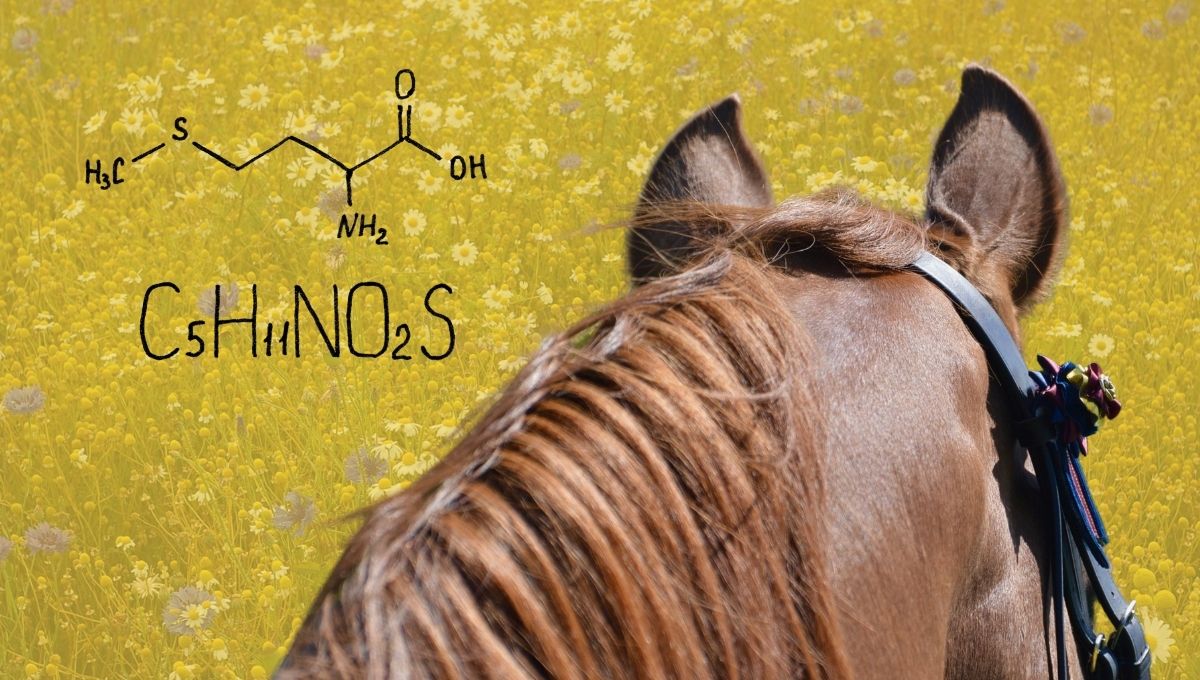
Methionine is an essential amino acid. Horses cannot synthesise adequate amounts of it in the body, so methionine for horses must come from the equine diet.
Like lysine, threonine and arginine, it is an amino acid required for the synthesis of muscle proteins, enzymes, hormones and other molecules.[4]
Methionine is one of the sulphur-containing amino acids, alongside cysteine and cystine. “Sulphur-containing” simply means the molecule contains sulphur, allowing it to contribute to compounds used in hoof, hair, skin and antioxidant systems.
Methionine is also often the starting amino acid in protein synthesis and acts as a methyl donor in reactions affecting the nervous system, cell function and other compounds.[3][4]
In animal nutrition, a limiting amino acid is the one in shortest supply relative to need. Lysine is traditionally recognised as the first limiting amino acid for horses, but methionine and threonine may also become limiting amino acids in some forage-based diets.[3][4]
Methionine is increasingly being recognised as a potentially limiting amino acid in modern forage-based equine diets, particularly where forage protein quality is low.[3]
Why Methionine Matters
Methionine supports far more than hoof health alone.
Methionine participates in protein synthesis, sulphur metabolism, antioxidant pathways and tissue maintenance throughout the horse’s body.
Hoof horn
Methionine contributes to keratin formation and sulphur-linked structural proteins involved in hoof horn quality.
Muscle & topline
Methionine, lysine and other essential amino acids are involved in muscle protein synthesis and tissue maintenance.
Skin & coat
Hair and skin rely on adequate protein quality and sulphur-containing amino acids to support normal structure, growth and keratin formation.
Antioxidant pathways
Methionine contributes to cysteine and glutathione production, helping support one of the body’s major antioxidant systems and wider cellular protection.
Connective tissue
Protein quality contributes indirectly to tissues involving collagen, cartilage, tendons and ligaments.
Immune function
Adequate amino acid supply supports normal protein synthesis and cellular processes involved in immune function and tissue repair.
Methionine should be viewed as part of the wider protein quality and essential amino acid balance of the forage-based diet, rather than simply as an isolated “hoof supplement.”
Dr Eleanor Kellon VMD’s 2026 article “Don’t Overlook Methionine” is an example of expert opinion suggesting methionine deserves more attention in modern equine diet formulation.[3]
However, much of this discussion is biological plausibility and expert interpretation, not proven causation from large clinical trials.
Important Scientific Nuance
Biological plausibility is not the same as proven causation.
Methionine has well-established biological roles in protein synthesis, keratin formation and antioxidant pathways. However, this does not automatically mean that every horse with poor hooves, weak topline or poor coat quality is clinically deficient in methionine.
Multiple factors affect hoof quality
Hoof horn can also be influenced by trimming, environment, copper, zinc, metabolic disease, moisture and overall energy intake.
Muscle loss is multifactorial
Poor muscle development may also reflect insufficient calories, inadequate exercise, illness, age or wider protein imbalance.
Not all forage is deficient
Sulphur and amino acid supply vary significantly depending on soil, fertiliser history, rainfall, forage species and management.
Supplementation should be targeted
Adding methionine without assessing the wider diet may not address the true nutritional limitation.
Key point
The strongest nutritional decisions come from forage analysis, wider dietary assessment and evidence-led interpretation, rather than assuming a single nutrient explains every problem.
Poor hooves, weak muscle tissue or poor coat can also reflect energy deficit, zinc and copper imbalance, disease, age, trimming, wet conditions or digestive tract issues.
Why Sulphur In Soil Matters for Methionine for Horses
Methionine for horses in forage ultimately depends on plant access to sulphur in soil. Grasses need sulphur to build sulphur-containing amino acids such as methionine and cysteine.[2]
Historically, sulphur entered UK agricultural soils through atmospheric deposition from coal burning and heavy industry, as well as organic manures and some fertilisers.[1][2]
Since 1990, UK sulphur dioxide emissions have fallen dramatically because of cleaner fuels, flue-gas desulphurisation and environmental regulation.[1]
That is excellent for air quality and health, but it may mean some British soils receive far less sulphur “for free” than older nutrient assumptions allowed.
Forageplus Data Insight
Over 1,000 UK equine soil samples analysed
Internal analysis of more than 1,000 equine soil samples submitted to Forageplus over the past decade has consistently identified sulphur as one of the most commonly limiting nutrients within the soils analysed.
Across these samples, sulphur frequently falls below the target ranges used within the Forageplus soil interpretation system, often resulting in recommendations for sulphur-containing amendments such as potassium sulphate, kieserite, gypsum or ammonium sulphate.
These findings reflect the equine grazing and forage-producing soils submitted for analysis and should not necessarily be considered representative of all UK agricultural soils. However, they do suggest that sulphur availability deserves greater attention within modern forage-based equine nutrition.
Internal Forageplus soil database, 2015–2026 (unpublished observational dataset; n > 1,000).
This is particularly important because plants require available sulphur to synthesise sulphur-containing amino acids within the forage itself. Lower sulphur availability in soil may therefore influence not only total forage production, but also overall protein quality and amino acid composition.
Sulphur, mainly as sulphate, is highly mobile in soil and can leach relatively easily, especially from lighter sandy soils, free-draining land and high-rainfall regions.[2]
Unlike some minerals, sulphur is not strongly held within many soil systems, meaning regular replenishment may become increasingly important under modern agricultural conditions.
As part of forage and soil balancing programmes, Forageplus will commonly recommend increasing available sulphur through carefully selected fertiliser inputs where appropriate.
Depending on the soil analysis and wider mineral balance, this may include applications such as Kieserite (magnesium sulphate), ammonium sulphate or other sulphur-containing fertilisers designed to improve soil sulphur availability and support healthier forage production.
Not all British soils are sulphur deficient, and requirements vary considerably depending on manure application, fertiliser history, soil type, drainage, rainfall and pasture management. This is why local conditions, analytical data and forage testing remain far more valuable than relying on broad assumptions or historic averages.
The Link Between Soil, Forage & Methionine
The practical chain is simple: soil sulphur influences forage sulphur; forage sulphur influences plant synthesis of methionine; forage methionine influences intake in forage-based diets.
Understanding The Chain
Soil health influences forage quality, and forage quality influences the horse.
Soil sulphur
Sulphur availability in soil influences the nutrients available to growing grass and forage plants.
Forage protein formation
Plants require sulphur to synthesise sulphur-containing amino acids such as methionine and cysteine within the forage itself.
Horse intake
Horses consuming forage-based diets rely heavily on grass, hay and haylage for amino acids, protein and mineral supply.
Protein quality & equine health
Amino acid availability may influence hoof horn quality, muscle maintenance, coat condition, recovery and wider protein synthesis throughout the body.
Key point: Modern equine nutrition does not begin in the feed bowl. It begins in the soil supporting the forage horses consume every day.
Low soil sulphur may reduce sulphur-containing amino acids even when crude protein looks acceptable. Forage sulphur is often estimated by laboratory analysis, sometimes alongside nitrogen to produce a nitrogen:sulphur ratio.[2]
Nitrogen:sulphur ratios can be used by agronomists and nutritionists when assessing forage sulphur status, although interpretation varies between systems and forage types.
Forageplus looks beyond headline crude protein by considering sulphur, minerals, protein quality and amino acid balance.
The relationship between soil sulphur, forage sulphur and sulphur-containing amino acid availability is biologically well established, although large-scale UK equine prevalence data remain limited.

Is Modern Forage Changing?
Modern forage is shaped by fertiliser use, grass varieties, climate, cutting stage, soaking hay practices and pollution controls. Common feeding practices like soaking hay can alter nutrient composition and may reduce some water-soluble nutrients.
Historic feed tables may not fully reflect forage grown under today’s cleaner air conditions.
Modern Forage Insight
Cleaner air may have quietly changed modern forage.
For decades, industrial emissions and coal burning deposited substantial amounts of sulphur into British soils through atmospheric pollution. Modern environmental regulation has dramatically reduced this input.
Before 1990
British soils often received substantial sulphur deposition from industrial pollution and atmospheric emissions.
Modern Conditions
Cleaner fuels, pollution controls and environmental regulation have greatly reduced sulphur dioxide emissions across the UK.
Potential Consequence
Some modern forage systems may now receive far less “background” sulphur than older feed tables historically assumed.
Why this matters: Sulphur is required for plants to synthesise sulphur-containing amino acids such as methionine and cysteine. Changes in soil sulphur availability may therefore influence forage protein quality over time.
This does not prove that all horses are methionine deficient, but it does support the growing need for modern forage analysis and closer attention to amino acid balance rather than relying solely on historic nutritional assumptions.
UK data show sulphur dioxide emissions have fallen by over 90% since 1990, while agronomy sources report sulphur responses in some grassland and crop systems.[1][2]
Forageplus has analysed tens of thousands of UK forage samples since 2005, seeing wide variation in sulphur, crude protein and minerals.
Some forages may provide adequate crude protein but suboptimal protein quality, particularly for essential amino acids such as lysine and methionine. This does not prove clinical deficiency in all horses, but it warrants assessment.
Could Methionine Become More Important?
Some equine nutrition experts, including Dr Eleanor Kellon VMD, suggest methionine may become increasingly important in modern forage-based diets as soil and forage patterns evolve.[3]
Lysine remains the traditionally recognised first limiting amino acid in equine nutrition, but methionine could become more relatively limiting in some circumstances.
Amino acid balance deserves particular attention for growing horses, performance horses, lactating mares, broodmares, older horses, senior horses, horses rebuilding topline and those recovering from illness. Precise methionine requirements can vary depending on age, workload, growth and overall protein intake.[4]
Some emerging research has explored altered amino acid profiles in horses with metabolic dysfunction, although the clinical significance remains unclear. Methionine may warrant consideration within wider nutritional support strategies, but it should not be viewed as a laminitis treatment.
Protein Quantity vs Protein Quality
Crude protein is calculated from nitrogen content. It does not show whether methionine, lysine and the wider balance of essential amino acids are present in appropriate amounts.
Key Concept
Crude protein tells you quantity, not quality.
A forage may contain a measurable amount of crude protein, but that figure does not confirm whether the horse is receiving the correct balance of essential amino acids.
Methionine, lysine and other essential amino acids may still be limiting even when total crude protein appears acceptable.
This is why amino acid balance, sulphur status and forage analysis provide a more accurate picture than crude protein alone.
Textbook examples sometimes reference hay containing around 10–11% crude protein, which on paper may appear adequate for many maintenance horses. However, extensive real-world forage analysis often paints a very different picture.
At Forageplus, analysis of thousands of UK forage samples has shown that many grass hays commonly fall closer to 5-6% crude protein on a dry matter basis.
Forageplus Data Insight
Crude protein does not tell the whole story.
Common crude protein levels seen in many UK grass hay samples.
Textbook hay values sometimes used in feeding examples.
Essential amino acid balance may still be poor even when crude protein appears acceptable.
A forage sample may appear adequate when judged by crude protein alone, yet still provide suboptimal levels of key essential amino acids such as lysine, methionine and threonine.
This is why Forageplus considers protein quality, sulphur status, mineral balance and amino acid supply together, rather than relying on crude protein as a single standalone figure.
While some forage samples do test at 10–11% crude protein or higher, these are far less common than many horse owners expect. This matters because low crude protein forage not only supplies less total protein, but may also provide lower levels of essential amino acids such as methionine and lysine.
Even where crude protein appears “acceptable”, protein quality can still remain suboptimal if amino acid balance is poor. A forage may therefore look adequate on paper while still failing to optimally support topline, hoof horn quality, tissue repair or muscle maintenance in some horses.
Horses cannot store amino acids in the same way they store fat or glycogen, so regular dietary supply remains important for normal protein synthesis and tissue maintenance.[4]
This becomes especially relevant where horses consume predominantly forage-based diets with little additional protein correction from compound feeds or balancers. Older horses, young horses, horses in work, pregnant mares and horses with reduced digestive efficiency may benefit more from improved protein quality and amino acid balance rather than simply increasing crude protein intake alone.
Forage analysis helps distinguish between total protein quantity and overall protein quality, allowing diets to be assessed more accurately rather than relying on assumptions based on historic feed tables or average values.
Practical Assessment
When might methionine deserve closer attention?
Where forage protein is low or sulphur levels are unknown, methionine may deserve more routine consideration within modern forage-based diets, particularly alongside lysine and wider essential amino acid support.[3]
Low sulphur forage
Forage analysis suggests low sulphur availability or an elevated nitrogen:sulphur ratio.
Hoof horn concerns
Hoof quality remains poor despite appropriate trimming, balanced minerals and adequate energy intake.
Muscle maintenance
A horse struggles to maintain topline or muscle despite appropriate workload and calorie intake.
Older or recovering horses
Digestive efficiency, recovery demands or protein quality requirements may be increased.
Forage-heavy diets
Horses consuming predominantly forage-based diets with limited additional protein correction.
Low protein quality
Total crude protein may appear adequate while essential amino acid balance remains suboptimal.
Key point: Methionine should ideally be considered within the context of forage analysis, amino acid balance, mineral status and the overall diet, rather than as a standalone supplement added in isolation.
As with any nutrient, supplementation should remain appropriately balanced within the wider diet once requirements are met.
Methionine can be supplemented to horses in various forms, including as a standalone supplement or as part of specialised horse feeds, with dosage depending on the horse’s specific needs.
It is often supplied as DL-methionine in a supplement or balancer. Precise methionine requirements can vary depending on bodyweight, workload, forage, hard feed and total dietary protein intake.[4]
Over-supplementation has potential negative effects, including unnecessary nitrogen excretion, additional cost and no proven added benefit once requirements are met.
Before changing a horse’s diet, consult an equine nutritionist to ensure proper nutritional balance and ratios, especially where liver or kidney compromise exists.
Looking Beyond Crude Protein In Forage Analysis
Understanding methionine starts with understanding forage, because grass and hay usually provide most of what horses eat.
A forage analysis can measure crude protein alongside key minerals such as sulphur, calcium, phosphorus, magnesium, copper and zinc. Whilst methionine is not routinely analysed, sulphur levels and the sulphur ratio can provide useful insight into the potential supply of sulphur-containing amino acids within the forage.[2]
Crude protein levels can also be used to estimate the likely contribution of important amino acids such as lysine. However, protein quantity alone does not tell the whole story. Two forage samples with similar crude protein levels may contain different amino acid profiles, meaning the quality of the protein can vary considerably.
Forageplus uses thousands of UK forage analysis results to identify common nutritional patterns in UK forage, helping horse owners better understand potential nutrient imbalances and formulate diets based on analytical evidence rather than guesswork.
For example, a 500 kg horse may be consuming hay containing 10% crude protein, low sulphur levels and an elevated sulphur ratio.
If that horse also presents with slow hoof growth, poor topline development or reduced muscle tone, we may then consider the overall protein quality of the forage and whether essential amino acids, including lysine, methionine and others required for muscle, hoof and tissue development, are being adequately supplied alongside supporting minerals.
Forageplus Position
Essential amino acids should be supplied consistently through the diet.
Methionine is only one part of the wider essential amino acid picture. Horses require all essential amino acids from the diet, because these cannot be made in sufficient amounts by the body.
Support the full amino acid profile
Focus on supplying all essential amino acids, not just one isolated nutrient.
Use well-formulated supplementation
Where forage-based diets may not reliably supply ideal amino acid balance, a carefully formulated supplement can provide more consistent support.
Balance the whole diet
Amino acid support works best alongside appropriate minerals, vitamins, energy, fibre and overall protein intake.
Targeted amino acid support is more useful than focusing on methionine alone.
Forageplus favours a practical, forage-focused approach: understand the diet where possible, then use well-formulated supplementation to help supply the essential amino acids horses must obtain through food.
Conclusion
Methionine is far more than simply a “hoof supplement.” It is an essential amino acid involved in protein synthesis, sulphur metabolism, antioxidant pathways and wider tissue function throughout the horse’s body.
At the same time, modern forage systems may not always reflect historic nutritional assumptions. Cleaner air, reduced atmospheric sulphur deposition and changing agricultural practices may all influence the sulphur and amino acid profile of forage-based diets in ways that are still being better understood.
Protein quantity is not the same as protein quality.
A forage may appear acceptable based on crude protein alone, while still providing suboptimal levels of key limiting amino acids such as lysine and methionine that horses must obtain from the diet.
This does not automatically mean that every horse requires methionine supplementation. Hoof quality, muscle maintenance and overall health are influenced by many factors including minerals, energy intake, management, environment and the wider balance of the diet.
The growing discussion around methionine reflects a broader shift within modern equine nutrition: moving away from historic feeding assumptions and toward a deeper understanding of forage quality, protein quality and essential amino acid balance within modern forage-based diets.
The most reliable approach is to:
Understand the forage forming the foundation of the diet
Recognise the importance of essential amino acid balance
Support the horse with well-formulated nutrition where appropriate
Avoid assumptions based purely on historic feeding models
As equine nutrition continues to evolve, the focus is increasingly shifting away from simplistic feeding assumptions and toward a more evidence-led understanding of forage quality, amino acid balance and long-term metabolic resilience.
References
Defra. Emissions of Air Pollutants in the UK – Sulphur Dioxide (SO2). Department for Environment, Food & Rural Affairs. Updated 2026. View source
AHDB. Nutrient Management Guide (RB209). Agriculture and Horticulture Development Board. Updated 2026. View source
Kellon, E. Don’t Overlook Methionine. Dr. K’s Horse Sense. Published April 13, 2026. View source
National Research Council (NRC). Nutrient Requirements of Horses. 6th Revised Edition. Washington DC: National Academies Press; 2007. View source
Forageplus Internal Soil Database. Equine soil analyses submitted to Forageplus between 2015–2026. Unpublished observational dataset; n > 1,000 soil samples.
Internal observational data are presented to provide context regarding equine grazing soils submitted to Forageplus and should not be interpreted as representative of all UK agricultural soils.